Q and A: How not having Internet access would affect our everyday lives

Interview with a Hoover High School teacher, a high school student, and a recent college graduate. I asked them what they use the Internet for in their everyday routine, if they could complete those tasks without the Internet, and how not having it would affect them.

Teacher

  1. What do you use the Internet for in your day-to-day routine?
    1. I use the Internet for Facebooking my friends (probably too much), banking, checking the weather, researching medical issues, communicating through email with family and friends, education programs that I have to use in my classroom, communicating with co-workers and teachers throughout the building.


  1. Is it possible for you to complete these tasks without the use of the Internet? If yes, how?
    1. NO, some I can but we rely so heavily on the Internet for most tasks that going back would be incredibly difficult.


  1. How would having little or no access to high-speed Internet make things different for you?
    1. Communication would come to a grinding halt because throughout the school system and at home we are very reliant on the Internet to communicate with each other, out of state family, doctors, etc. It would also make tasks at work much more difficult because we would have to go back to the pen and paper method. It would also be much more difficult to access information, I feel like I would be much less informed of what was going on around me.


  1. From a teacher’s perspective, do you think it is harmful that school systems are relying so heavily on the Internet?
    1. I do think that there is a population that cannot access the Internet and it can be harmful when it makes them feel different than other students and puts them at a disadvantage for completing assignments. It then also becomes harder on the teachers who have to create assignments in multiple versions so that everyone can complete it effectively.


High School Student

  1. What do you use the Internet for in your day-to-day routine?
    1. Teachers post the assignments online and they have to be turned in online a lot the time now. I talk to most of my friends on Facebook, Twitter, and post pictures on Instagram.  I also use it to practice for the ACT, research for class, and research colleges.


  1. Is it possible for you to complete these tasks without the use of the Internet? If yes, how?
    1. I would not be able to complete my school assignments as easily without the Internet. I could do all of these things minus social media but it would take a lot longer.


  1. How would having little or no access to high-speed Internet make things different for you?
    1. School and studying would be a lot harder. I would also feel left out if I couldn’t be on social media with all of my friends.


Recent College Graduate

  1. What do you use the Internet for in your day-to-day routine?
    1. I use it constantly at work, for paying bills, trading stocks, buying car parts, keeping up with the weather, watching movies, playing video games, and constantly for email. When applying for jobs I had to use it to upload my resume, fill out online applications, take online tests, and fill out forms.


  1. Is it possible for you to complete these tasks without the use of the Internet? If yes, how?
    1. There are some things I could do such as paying bills and watching movies but it would take much longer because I would actually have to go places to do these things and with work there sometimes isn’t a lot of time left in the day.


  1. How would having little or no access to high-speed Internet make things different for you?
    1. Getting a job would have been very difficult because most of the application processes are done online now. I would also get a lot less done because I work 8-5 I would have to find other times to physically run errands instead of getting it done from my phone or computer at home.

The conclusions were all basically the same. We are all so reliant on the Internet that we make some tasks that should be available to everyone exclusive to those with easy access to Internet. If we try to imagine our lives without high-speed Internet, we can put ourselves in the shoes of those not as fortunate and work to make sure everyone has better access.
Posted in Q & A | Tagged , , , | Leave a comment

Comcast Buyout of Time Warner and the Digital Divide

The recent news that Comcast bought out Time Warner for $45.2 billion in stock happened relatively quietly, but the acquisition has major implications for our country’s growing digital divide. The New York Times blog post describes the inner workings of the deal. Evidently, Time Warner executives approached Comcast, and an agreement was brokered as Comcast’s CEO Brian L. Roberts was in Sochi, Russia, where he was wining and dining with Vladimir V. Putin at the Olympics (Comcast owns NBCUniversal, which has the exclusive broadcast rights to the Olympic Games). Comcast, which was already the biggest media company in the world, took an even stronger grip on the US broadband internet and cable market with the purchase.

Roberts went on a CBNC interview show and argued that this merger is a “pro-competitive” move, a ridiculous and somewhat insulting statement to make. The cost of broadband internet and cable has skyrocketed, and Comcast’s stock value has quintupled since 2009, mostly because of its growing monopoly. Continue reading

Posted in Current Events | Tagged , , , , , , , | Leave a comment

The Digital Divide and Education

Dreamers

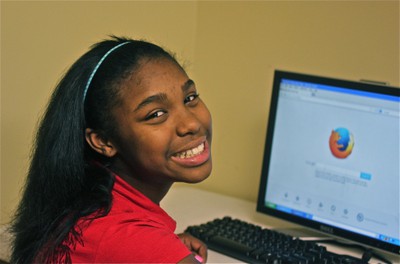
One of the “Dreamers” during computer time at the I Have a Dream Foundation of Asheville. Source: www.ihadasheville.org

I should thank you all; our class last week inspired a (hopefully) fun and engaging new activity I’m going to do during library instruction for English Composition students (under construction here). It was really interesting to hear you talk about how you conceptualized yourselves as Digital Natives. It’s a term that gets thrust upon any person of traditional college age right now (as well as K-12 students), but I think there are a lot of nuances to the term that are worth considering.

One of those nuances is the Digital Divide.  When I was preparing for my English Comp class, I turned to Born Digital, a book that addresses the generation gap between Digital Natives and Digital Immigrants.  I was interested in this quotation because it addresses how everyone of Digital Native age doesn’t necessarily meet the definition:

Children who spend more time online—Digital Natives—are more likely to be better equipped to make judgments about information quality.  Studies show that children who have the most extensive access to the Internet are more likely than their less experienced peers to take a skeptical view of the kinds of information they draw from Web-based sources like Wikipedia.  A possible way to explain this phenomenon is that children with unrestricted access have the time to experience knowledge production as a collaborative experience, while young people who access the internet, for instance, through computers in the library need to get the information very quickly and thus don’t have time to evaluate their sources carefully.

Palfrey and Gasser 166

This quotation gets at the idea that not all young people today are equally adept at using online resources, but it tiptoes around the underlying issue that’s creating a Digital Divide even among Digital Natives–social class.

Continue reading

Posted in Discussion, Wild Card | Tagged , , | 1 Comment

The Digital Divide: A Links Roundup

What is the Digital Divide?

The Digital Divide is basically a gap in access to information (via the Internet and ICT) between different groups. Groups like the Broadband Commission for Digital Development, the Digital Divide Institute, the Digital Divide Network, and the State Educational Technology Directors Association (SETDA) work in different ways to advocate for equal access to information.

What’s the problem?

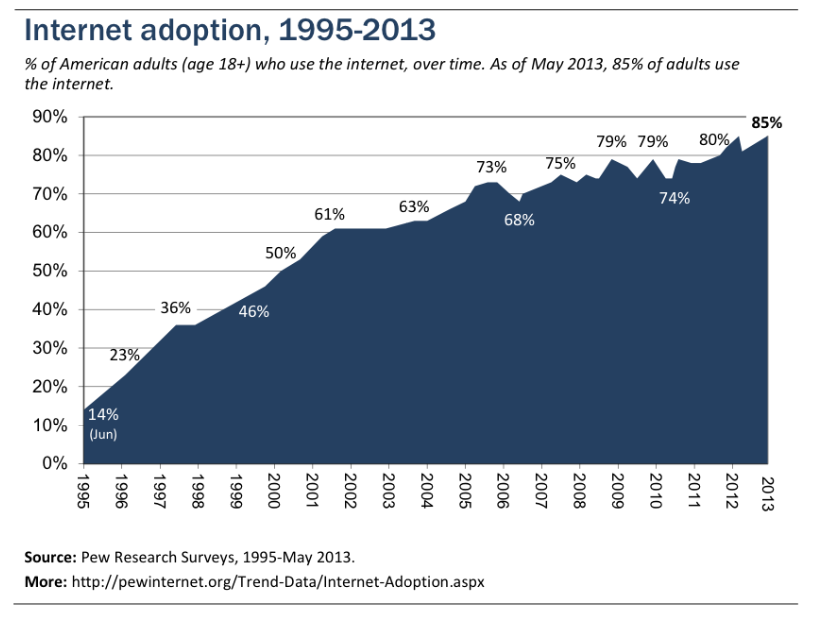
Internet Use Over TimeEven though overall Internet use has drastically increased, there is still a divide between high-speed wired broadband access and second-class wireless access because there is virtually no competition in cable/Internet markets. This drives up prices and can even limit access geographically. Access to ICT and Internet is also linked to gender inequality. It is estimated that 200 million more men than women have internet access worldwide. Continue reading

Posted in Links Roundup | Tagged , , , , , | 2 Comments

Critical Thinking and Education: Questions to Consider

Here are a few questions about the readings and video to think about before class:

  • What is the link between critical thinking and information?
  • Why is it so important to teach students how to fact-check and locate reliable information?
  • Do you think being “digital natives” helps or hurts us?
  • What does standardized testing suggest about information?
  • When is accessing information not enough? What good is information if you have it but don’t know how to use it?
Posted in Discussion, Miscellaneous | Tagged , , , | 1 Comment

Test Scores May Not Have All the Answers: Understanding as a New Educational Approach

Boy_Taking_ExamSources say America’s education system is lagging behind other countries; whereas it used to be a global leader. Some politicians have raised the stakes, claiming this decline poses a “national security threat.”

One of the many possible explanations for this decline is America’s obsession with test scores. (See also: America’s Toxic Culture of Testing; How Test Obsession Is Killing Education; and Standardized Testing: The Monster that Ate American Education.) Continue reading

Posted in Discussion, Links Roundup | Tagged , , , , , , , | 1 Comment

Honors Program Trip to the Birmingham Civil Rights Institute

Now announcing the University of Montevallo Honors Program field trip to the Birmingham Civil Rights Institute. On Wednesday, March 5 a UM Honors Program van will leave the Hill House at 12 PM. To reserve a seat on the van, please e mail honors@montevallo.edu.

If you’ve never been to the BCRI before, I strongly encourage you to join in on this trip. There are many elements of information and media at play in the construction of the museum, and we would certainly be excited if someone chose to do their “Review” writing invitation blog post on their experience.

Civil Rights flyer

Posted in Announcements | Tagged , , | Leave a comment

Broken Democracy: Why I Should Pay Closer Attention to Edward Snowden

You are someone who is smart enough, idealistic enough, bold enough to know that living with yourself in a system of utter corruption would destroy that self as an ideal, as something worth being. Doing what you’ve done, on the other hand, would give you a self you could live with, even if it gave you nowhere to live or no life.

–Rebecca Solnit, “Prometheus Among the Cannibals”

I kind of wanted to write an open letter to Edward Snowden in the vein of Rebecca Solnit’s “Prometheus Among the Cannibals,” but I figured my letter would be nothing more than a confessional, and I didn’t want to cheapen Solnit’s rhetorical approach. I have not taken the time I should to investigate the information that Snowden risked his life to release. And I have not taken the time to follow closely our own government’s response to Snowden’s actions. In some ways, I have failed as a citizen of this country because I have not taken advantage of the very access to information that is so important and that Snowden’s disclosures seek to protect.

Sure, I generally know about Snowden. He was a contractor who worked for the National Security Agency who disclosed documents and information to U.S. journalists about a massive U.S. surveillance program. And I know that he was forced to flee the U.S. and is now living in Russia, having been granted political asylum. But beyond that, most of the key elements of his revelations have slipped under my radar.

For instance, I did not know the following things:

  • A U.S. government program called PRISM allows for anyone’s Yahoo or Gmail accounts to be accessed by government investigators.
  • The NSA harvests e mail contact lists and runs a program called XKeyscore, which makes it possible for them to track virtually anything we do online.
  • The U.S. military blocked access to The Guardian, one of the international news outlets that published many of Snowden’s leaked documents. Continue reading
Posted in Wild Card | Tagged , , , , , , , | Leave a comment

Social Media & Volunteerism

Mallory Mitchell, a senior marketing student at the University of Montevallo, has done undergraduate research related to our topic at hand: activism and social media. As a part of the McNair Scholars Program, Mallory worked with Dr. Michele Bunn to analyze Social Media’s Influence on the Motivations of College Students to Volunteer. The full paper is published online in Unconventional Wisdom: University of Montevallo McNair Scholars Program 2013 Research Journal.

UM Senior, Mallory Mitchell

UM Senior, Mallory Mitchell

Will you briefly summarize your research on the connection between social media and motivation to volunteer?

We found that those students who volunteered at a high or moderate level also used social media at the same level. They were more likely to use Facebook and LinkedIn to engage with others, especially nonprofit organizations. Continue reading

Posted in Q & A | Tagged , , , | Leave a comment

Pros and Cons of Social Media Advocacy

Like the articles have shown, and most of us have stated in our posts, there are pros and cons to advocating for a cause over social media. These social media outlets have become a way for connecting and communicating that we never knew would exist. Now, people can share ideas, spread messages, and team up in ways they never could before with people all over the world.

There are many examples of how this is a good thing. For example, getting justice for Renisha McBride. Without its own personal hashtag and other online advocacy, this case made not have been picked up by the media and in turn put pressure on the justice system. There are other examples such as a campaign called “Tweetsgiving”. Epic Change used twitter in a way that used storytelling to gain support for projects and people in need. They would tweet around Thanksgiving, asking people to share what they were thankful for, while also sharing stories of people in need. Those that shared their stories, rose awareness, and raised money for those in need through donations. Mama Lucy shared her story, ended up raising enough money to start a school and became the first successful social media fundraising campaign. Without this important tool, raising enough money for her school would not have been a reality. http://epicchangeblog.org/experiments/epic-thanks-tweetsgiving/

Social Media also has a dark side. Allowing people all over the world access to your thoughts and feelings opens up the potential for (sometimes very harsh) criticism. Katherine Cross, a Puerto Rican trans woman working on her PhD “wrote about how she often hesitates to publish articles or blog posts out of fear of inadvertently stepping on an ideological land mine and bringing down the wrath of online enforcers”. When we post on social media there is always a risk of being attacked by ignorant people or people who’s ideas differ from our own. Posting can sometimes be a scary thing.

http://www.thenation.com/article/178140/feminisms-toxic-twitter-wars

Posted in Discussion | Tagged , , , , , | Leave a comment