Check out my Buzzfeed post!
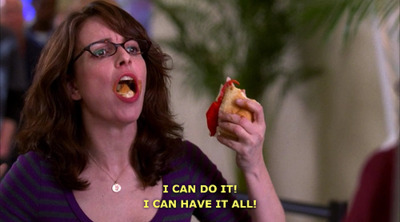
You can have it all, Liz Lemon. You can.
Check out my Buzzfeed post!
You can have it all, Liz Lemon. You can.
After listening to Flora Lichtman interview Maria Popova on npr, I decided to do a review of her website brain pickings. During the interview, she talked about the idea of being a curator, plagiarism, and her curator’s code, so I thought it would be interesting to review her website and see how she makes sure that artists get credit for their work. One article that I read, “How to Break Through Your Creative Block: Strategies from 90 of Today’s Most Exciting Creators”, is a great example of how she does this. Popova has a thought, question, or idea that is interesting to her and does research and writes an article about it. In this particular article, she talks about at least 9 authors/artists and their ideas for overcoming their creative block. While talking about them in her own writing, she links the reader to their personal page, links to amazon to buy their book/work, and links to other articles about them. Though she is a “hunter-gatherer” of information, she makes sure to link back to the original works and their authors throughout her posts.
Last year the media and business world became alarmed with Jeff Bezos, the owner and founder of Amazon.com, purchased The Washington Post with money from his own pocket. Even though the Post is not directly an Amazon property, the slippage between Bezos’s personal and professional interests have been seen acutely in the pages of the paper since the purchase. Most notably is the way the Post covered Amazon’s announcement of Amazon Air, a futuristic method of delivering products with miniature unmanned aerial devices (drones).
Mostly, the Washington Post was uncritical of Amazon’s program but instead did a links roundup post of its own on some of the criticisms against Amazon in the wake of the announcement. Continue reading
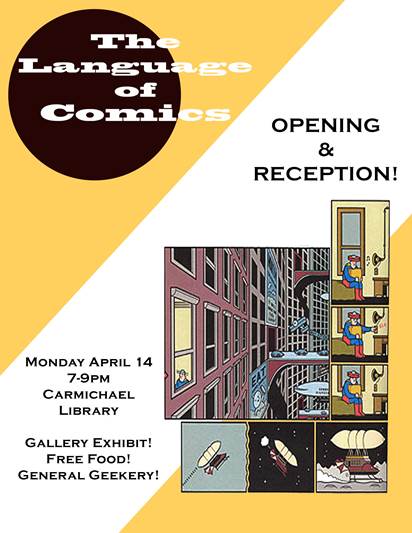
Come visit the opening reception of the Language of Comics. This is an interesting presentation of comics as a visual art and cultural medium. Hope to see you all there!
Recently I watched a movie that I feel you all should watch at least once in your lifetime, The Pursuit of Happiness. It is about a man named Christopher Gardner( Will Smith) and his son.
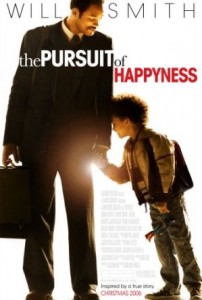 The sad fact about Gardner story is he did not always have nothing, but made one bad business decision and lost all that he owned including his wife. In order to get a job he had to take a six month unpaid internship, and continue to try and sale the horrendous machine that had made him poor in the first place. He was not even guaranteed a job with this internship. This story follows him and his son through a life of poverty that Gardner is finally given the knowledge to to escape from. I give a 4 of 5 stars!
“Information is the currency of today’s world. Those who control information are the most powerful people on the planet-and the ones with the most bulging bank accounts.”
-Matthew Lesko: The Confessions of a Millionaire Information Broker
Questions to Consider:
Do you think information and the sharing of it can challenge inequality?
Can freeing facts and information help pull people out of poverty?
Why do you think people have the need to control information?
How does all of this relate back to the digital divide?
The two articles we are covering for this week seem to agree with each other, even though they come from publications that are known to be in direct ideological opposition to one another. Poor education is more a product of poverty than it is a symptom of flaws with teaching, problems with educational standards, or the existence of teaching unions. And the link between education and poverty is clear: the less educated one is, the more likely he or she is to languish in poverty. Similarly, the more impoverished a person is, the more likely he or she will under-perform educationally. It’s a bad cycle.

So how do we in Alabama fit in to this cycle? Today I saw a link to an article that seems to indicate the Hoover School System bus imbroglio has resurfaced. Evidently, the Hoover Board of Education has filed a request with the Department of Justice to implement a fee for students who ride the bus to school. Like a lot of articles about civic life in Alabama, this reads like a piece that you’d see in The Onion.
Last December, the Board initially voted to end bus service for most students in its district, but then they rescinded the decision. Now, the Board has filed a proposal to implement a fee schedule that would charge students who need to ride the bus to school. Curiously, though, the Hoover school district is refusing to make their fee proposal public.
Many families in the Hoover district want to know details, especially the key detail of how much this fee will be if in fact it will be implemented. Predictably, these are people who do not own homes and do not have the luxury of driving their children to school in privately-owned vehicles. They want to know if they will be able to afford to send their kids to school or if they should move to another district that does provide bus services.
The end of public bus services by Hoover is tantamount to ending public education. It’s a mechanism designed to keep poor students out of the district, and it is a 21st-century exercise of social segregation. Hoover school officials complain about a budget deficit, yet the condition of education in that district is better than just about anywhere in the state.
This is just one more example of many other discussions we’ve been having this semester about the clear links between educational quality and access to information. I’m curious to hear what other people in the class think. Why do so many articles talk about the connection between poverty and education but then stop short at naming all of the ways that our best school districts actively work to draw boundaries between the rich and the poor? Furthermore, what can we do about it?
According to our reading, The Privatization of Public Knowledge, the constitutional purpose of copyrights were to “advance and diffuse knowledge”. What it has turned into is a monopoly and exclusive ownership of intellectual property that extends longer than it was originally intended. Many laws have come out extending the length that information can by copyrighted. It has even gone so far that many groups including MPAA (Motion Picture Association of America), The Center for Copyright Information and iKeepSafe are trying to implement copyright law into elementary education. Internet service providers have also come up with a plan to stop copyright infringement through illegal downloading. This plan includes email warnings, warning browsers, and the slowing and taking away of Internet access. It is funny though when the tables get turned: a political party was accused of pirating by a news editor and paid for it!
Check out Chilling Effects for FAQs and Answers about copyright and fair use. If you are unsure of whether or not your use of copyrighted material is fair, look at these 5 questions to ask yourself.