
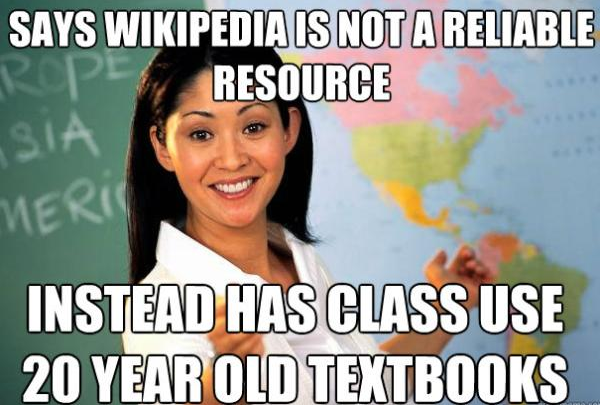
 I think Wikipedia can be a reliable source. There, I said it. Take me away to librarian jail!
We’ve talked on and off this semester about the ideas of authorship and credibility, as well as the levels of value we assign to print vs. online sources. When it comes to “real” or “serious” research, the credibility buck seems to stop with the author: can you tell who it is, and what his or her credentials are? And when it comes to finding information, even though we might find more of our information online, we still assign higher value to print sources. Even though our information seeking behaviors look a certain way because of the proliferation of online resources, there’s a lot of stuckedness in days of yore in terms of how we value and use information.
These are all a lot of generalizations, so let me put some of this in perspective. When I teach English 101 and 102 library classes, one of the skills students need to practice is finding background information about whatever topic they’re researching. I present them with a few different resources to go about finding background info: obvs Wikipedia, but also Credo Reference, Oxford Reference, and sometimes Opposing Viewpoints. These last three are library databases, and Credo and Oxford are specifically collections of digital reference books. When I talk about these resources, I often explain them as :”like Wikipedia but you know the information is credible.” I kind of cringe a little when I say this, and occasionally I go on a rant about how all authors have bias, no matter what their credentials and even if they are writing in a supposedly unbiased form, like a reference entry.
The thing is, there’s so much more available in Wikipedia than there is in Oxford or Credo or Opposing Viewpoints. The authors of Wikipedia articles might not have PhDs in their field, but often they have some kind of vested interest, maybe based on personal experience, like Kayla and Katie mentioned in their posts. Or maybe they have a specialized understanding of a useful way to organize information, like Rachel explained. There is so much power in a medium that welcomes many voices. Why don’t we think that information is more credible when multiple people have created it, rather than one all-powerful person with a certain degree behind his name?
The other troubling thing that I often say in English 101 and 102 is that “Wikipedia is a resource, not a source.” Meaning, you can use it to get an overview, build a list of vocabulary related to a topic, maybe even find some articles worthy of citing in the references section, but you can’t actually cite the Wikipedia article. The students are already programmed not to cite Wikipedia; some of them act like it’s a sin to even look at a Wikipedia page. So why this invisibility of Wikipedia? We’re all using it. I use it everyday. I used it before our class last week to remind myself of theorists who had written on the idea of authorship. Those English 101 and 102 students might be finding print resources using the ideas and maybe even the actual citations they’ve gotten from Wikipedia articles, but the Wikipedia articles themselves are a blank, an unmentionable part of the research process.
Academia is good at upholding the status quo. It’s especially committed to traditional ideas of publication. In the humanities, most publishers can barely wrap their minds around the idea of a co-authored article or book. And in the sciences and social sciences, usually one researcher is designated the “lead author.” So much hierarchy. So much bullshit. Academic publications don’t make money, and yet e-books publications are suspect (even though they don’t need to be printed and bound, which would save a lot of the money that isn’t being made). This all goes back to Week 3, when we talked about students and professors and the cycle of power in academia. Professors ask their student to replicate power structures when they render Wikipedia invisible. How long is it going to be until we revise our idea of what good, credible, citable, information is?
Postscript
As usual, I don’t have any solid conclusions, but I do want to post a link to the Wikipedia article on feminist pedagogy, which I contributed to last semester. I did an online professional development course about feminist pedagogy for library instruction, and our final assignment was to work in a group to edit a part of the feminist pedagogy Wikipedia article. I have to admit that until then, I had no idea how difficult it actually is to edit a Wikipedia article (Hannah gave a great description of this process in her post). I love Wikipedia for its accessibility, but it still excludes people as editors and as readers.