

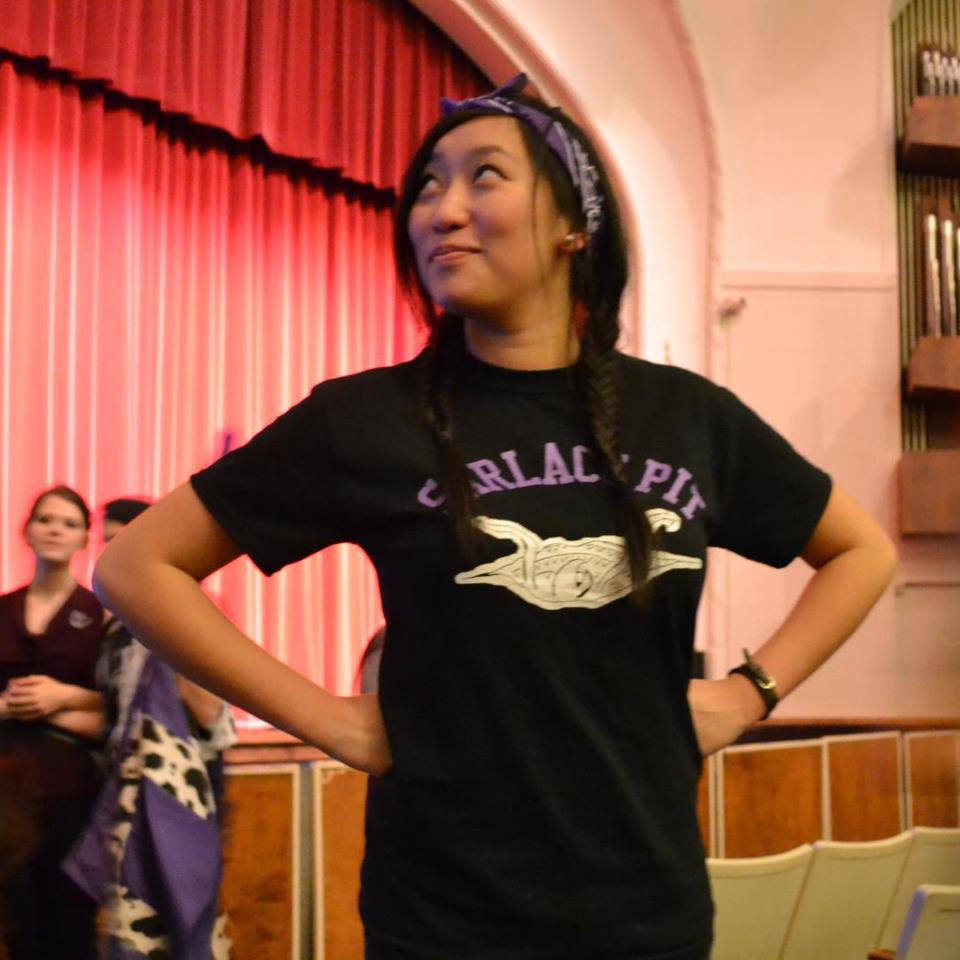
Tanya Hoang: Feminist Extraordinaire
I chose to interview Tanya Hoang as she is both a self-identified feminist and an Asian American woman. I thought it would be pertinent to get her perspective on some of the issues we read about this week.
What are your thoughts on feminism?
I think feminism is a wonderful movement. I’m a big supporter of it and I encourage others to support the cause, because I believe anyone who supports human rights is, by my definition, a feminist.
What do you think are our greatest concerns regarding women in our age group and/or in our local community?
I think our greatest concern is women being complacent in arbitrarily defined gender roles—like being submissive. I don’t think I see enough females striving to break the glass ceiling or striving to be role models or leading examples for other women.
Do you think the women in our local community face any specific challenges?
I think us women in the south face more gender stereotypes and discrimination than nationwide, as the south is historically very patriarchal and endorses strong paternal roles. Women my age almost seem to forget that the women who came before us made significant progress made for us—they made a pathway for us—and they don’t seem to want to go farther and see what possibilities are out there.
What feminist issues resonate the most with you?
Reproductive rights, mainly. It’s a huge concern for me and it wasn’t huge concern until last year, which is when I volunteered for a Planned Parenthood charity event called the Birds and the Bees Bash. The event was held in order to raise money for sex education purposes. Personally, I didn’t receive a comprehensive sex education when I was in school and I feel like I would’ve really benefitted from one. I doubt that other women in this state are receiving an adequate sex education either.
Have you ever participated in an online movement in the form of a blog, website, or other online medium?
I did in 2010 when I was in high school. I went to a high school that heavily endorsed patriarchal systems of authority. There was this idea that “our men are our heroes” and everything centered around the men’s football team. The movement was to spread the word that independent girls at our school were going out into the community and effecting real positive change, and others could join if they wanted.
Why did you choose to participate in that movement?
Largely because of my sister. She and her friends were a big part of it. You know, your sister is always so cool and I wanted to be more like her. She’s a really self-sufficient female and I admired her for being so independent when all the other girls I saw in high school weren’t like that.
Do you think if you hadn’t had a close friend or family member in the movement that you might’ve been less likely to get involved?
Well I had a lot of other friends in the movement as well. I think I was bound to join.
Do you think on a national or even global scale that online movements are effective in changing norms or beliefs or in mobilizing supporters?
I agree one-hundred percent because we’re living in the information age and the internet is how you get your information—your message—out there. I think that online movements largely contribute to social justice movements we see on the news or at least take action in response to them. Take for example the girl who was shot in the Middle East for standing up for her education. Now millions of girls have heard her story thanks to social media and have new inspiration to fight their own causes locally.
Do you think that these online movements specifically incite people to action?
Yes. Almost everyone knows someone who’s a part of these movements or is at least affected by them, which is all the motivation they need. The internet spreads the message and the information you need, which is the first step in doing something about the issue.
Do you mind if we also talk about your experiences as an Asian American?
No problem.
Do you ever feel marginalized as an Asian American?
Negatively? Yes. I first heard about the glass ceiling. Then I was introduced to the bamboo ceiling, which I find even more offensive.
Can you explain?
Supposedly Asian women can only go so far in the workforce because of our ethnicity. Still, some Asian stereotypes work to my benefit. Being Asian gives a lot of people faith in me and what I can accomplish, which kind of motivates me to prove my credibility and capability.
Are you ever faced with stereotypes here in Montevallo?
Not on campus. I don’t think so. If I have I’ve repressed it. Sometimes I come across people who are ignorant but I think that’s due to the fact that we live in the south and diversity is scarce. How can they possibly understand how to be politically correct when they have such limited experience with diversity? Off-campus, I’ve heard really derogatory remarks. Maybe they just weren’t raised to know any better. You can’t get mad at someone for being ignorant.
What do you see, whether it be a politician, a social movement, a societal figure, or just a dialogue in general, as being a key factor in changing stereotypes and discrimination for all peoples?
I think that an actual political figure would be fantastic, but I think change will probably stem from social media celebrities who push boundaries on a daily basis. I mean that’s where a lot of people get their news and most of their political ideology influence.
Do you have any final thoughts on feminism or your experiences as an Asian American?
Being an Asian American doesn’t really affect my life dramatically until it’s put in my face. I feel like I have to sit on this polarized spectrum. Sometimes I have to put my culture on the back-burner so I can be an “American” as opposed to being an American who is also ethnically Vietnamese. Because people don’t understand what it’s like to juggle two cultures, sometimes I get pegged as being “white-washed”—as in people discredit my Vietnamese background. Also, Asian women, in my family at least, really pride themselves as being independent, especially financially. I think that fact has gone a long way in helping me appreciate the feminist movement. I think it’s important that we remember the women who came before us and put us on a pathway to better lives. I hope that one day people won’t see feminism as this radical notion. It’s really about human rights.
My thoughts: I thought it was particularly interesting that Tanya felt that her sister and friends’ involvement in the social media movement was key to her involvement as well. I also find it noteworthy that Tanya believes this generation (the generation of the information age) is increasingly looking to the internet for news. I also thought it was interesting how Tanya tied low-risk activism (social media movements) with strong-tie activism. It seems to me that she believes online activism is enough to inspire people to actually go out and do something if they have a friend or family member connected to the movement in a personal way. I agree with Tanya that online social activism is a very important first step in inciting action. Before people can be sufficiently inspired to do something, they must first be involved in a dialogue centered around the issue. I know that personally, I have been inspired to engage in demonstrations as well as volunteer as a result of information I received online. I believe that my experience with online social activism is probably not too different from others of my generation, who may have also been inspired to act as a result of social media.
So, class:
Have you ever been led to action because of an online movement?
What do you think it takes to bridge the gap between online activism and physical action?