

The economics of scholarly publishing
This week we’re talking about a series of issues related to the cycle of information in the academy. They all involve the cost of producing and consuming information that is deemed to be “scholarly.” Many of us are newcomers to the table in higher education, and we need to see how the demands of publishing and accessing information affect all of us. Even if we aren’t currently tying to publish articles in academic journals, the economics of scholarly publishing directly influences our education.
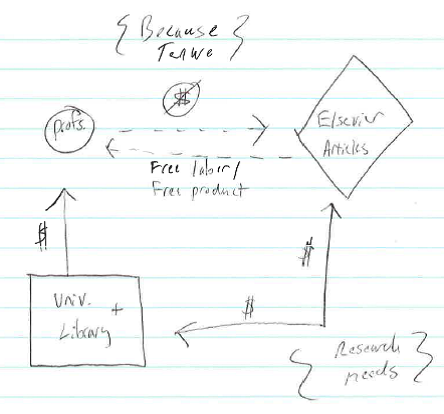
I’ll never forget my early days in graduate library science classes, in which I realized for the first time that universities pay (at least) twice for their scholarly information. I was in a collection development class at SUNY Buffalo, where I saw a guest lecturer angrily scratching a series of arrows and circles onto a chalkboard. He explained that library budgets were increasingly being allocated to proprietary database companies at the expense of libraries and librarians. Money that used to be spent on books, furniture, technology, and other things libraries need now goes to major companies like Elsevier, which make millions of dollars each year by selling content back to universities at an exorbitant price.
To gloss my retrospective illustration above, universities pay professors a salary to research and write articles, which professors then surrender for free to companies like Elsevier, which in turn charges those same universities lots of money to access the very product that was given to them. If we were to translate this into the economics of the lemonade stand, the cycle would look something like this:

If neighborhood lemonade stands operated like scholarly publishing
Let’s say a guy is really thirsty and wants some lemonade. Instead of going to the store to buy a bottle, he decides to spend lots of time and money growing lemon trees and purchasing juicers and bottlers. Then, after bottling the lemonade, he gives the bottles to a juice-selling company for free, and then turns around and buys the lemonade back at $100 per bottle, or about 30 times what the lemonade should cost, just because he’s really thirsty.
This, of course, makes no sense, but it’s what every single academic library in the United States is forced to do each year. It’s no wonder that academic library budgets are suffering while companies like Elsevier make $2.27 billion or more each year in profits. It really helps the bottom line when you get free product and then can (theoretically) charge whatever you want for it.
We have to ask, as Timothy Gower does in his famous blog post, what value are these database companies adding to higher education? Gower writes that university professors and libraries have a lot more leverage than we realize:
[I]f all libraries were prepared to club together and negotiate jointly, doing a kind of reverse bundling — accept this deal or none of us will subscribe to any of your journals — then Elsevier’s profits (which are huge, by the way) would be genuinely threatened.
Libraries and academics need to band together and put a stop to this economic cycle. Gower himself pledged never to write or edit for a journal that was owned by Elsevier, no matter how prestigious it is.
So what’s going on behind the scenes of this economic model? It seems to be some complex set of assumptions about the responsibility of scholars to produce information and the “authority” that certain forms of information carry. Scholars are compelled to write articles because their jobs depend on it. No articles, no tenure. But professors can’t just write whatever they’d like or publish it wherever they’d like. Instead, they have to target publications for venues that are deemed to be “authoritative” in their respective disciplines. What constitutes authority? Subtle assumptions, reputations, perception, and prestige. Systems like Thompson Reuters’ Web of Knowledge or Google Scholar metrics establish impact factor rankings to measure the worth of journals. Other disciplines are less empirical. For instance, anyone in who publishes an article in PMLA has to some degree “arrived” in the field of English literary criticism and cultural studies.
People preserve their own livelihood above all else, and it’s often too much to ask a single individual to work outside of the system and stand up to corporate greed when doing so could mean career death. Many scholars are too scared to publish in open access or electronic-only journals because these are deemed to be less influential than traditional venues.
The cycle comes full circle when undergraduate professors demand that their students only use peer-reviewed articles as forms of evidence in their work. What does this mean for us as students? That “peer-reviewed” sources that come from scholarly databases are the only viable forms of information? That citing peer-reviewed sources is the only way to establish credibility when one is a young, unproven thinker?
I am interested to hear what you all have to say about the question of authority and information in the context of scholarly publishing.
5 Responses to Universities Pay Twice for Information